|
Spanish troops in Naples
As I mentioned a couple of posts ago I recently purchased some of the new Perry Condottieri figures. As these are really only suitable for the very early stages of the Italian Wars this got me thinking about how the figures in my collection are suitable for different parts of the wars. I also wanted to see what my Spanish army was looking like with the addition of the figures I have been working on over the past few months, since I set it all up over a year ago (the pictures from then can be seen here: http://camisado1500s.blogspot.co.uk/2011/05/spanish-kingdoms.html ). So when I had a chance this summer I set it all up and took some photos. This is set up is an army I feel would be most suitable as the Spanish forces of Ferdinand of Aragon who fought under Gonsalvo de Cordoba in southern Italy.
|
 |
| Spanish Army |
 |
Spanish Army
The below three pictures are of the Spanish cavalry, most of the figures are from the Assault Group. Their figures are perfect for the early Italian wars. The 3rd photo shows my conversions of the plastic Perry Men at Arms. I was keen to see how they fit in with the other figures as I feared they may look too medieval but I am pleased with the result.
|
 |
| The Spanish Cavalry |
 |
| Spanish and Italian Horse |
 |
| Spanish Light Horse |
 |
Colonna Crossbowmen
The above photo is of my converted Perry mercenaries with a few Assault Group figures as command. I used old citadel figures to convert them as shown here: http://camisado1500s.blogspot.co.uk/2011/08/gascon-crossbowmen.html . They are quite generic and as such are very useful for this period. I think the Perrys are set to release "Italian Heads" for the plastic infantry and I still have the pieces from the old citadel empire handgunners set left for conversions so I may well be working on another set of these at some point. In this photo they are under the flag of the Colonna family fighting as Italian mercenaries in the Spanish army.
|
 |
| Spanish Crossbowmen |
The above photo is of another converted regiment, this time they are the old citadel Marksmen of Mirigliano that I bought off ebay although it looks like they are still available, but expensive, on the Games Workshop site. I am pretty sure they were sculpted by the Perries and I feel they fit in well as crossbowmen in the early Italian wars.
 |
| Spanish Rodeleros |
 |
| Spanish Rodeleros |
The above and below photos are of my Spanish infantry, mostly Assault Group and old Wargames Foundry figures.The blue and red banner is for Pedro Navarro,
http://en.wikipedia.org/wiki/Pedro_Navarro,_Count_of_Oliveto . An interesting character of the Italian wars with possibly a background in piracy, he was an excellent siege engineer. He fought first for the Spanish and later for the French so this flag could be seen flying in different armies at points. For the early war in Naples I am not sure if this was his standard as he was not made Count of Oliveto until after the battle of Garigliano in December 1503. The flag is a Freezywater one taken from the Lance and Longbow Society book on Marignano in 1515 (by which time Navarro was fighting for the French) and is based on conjecture.
 |
Spanish Pike under the banner of Pedro Navarro
|
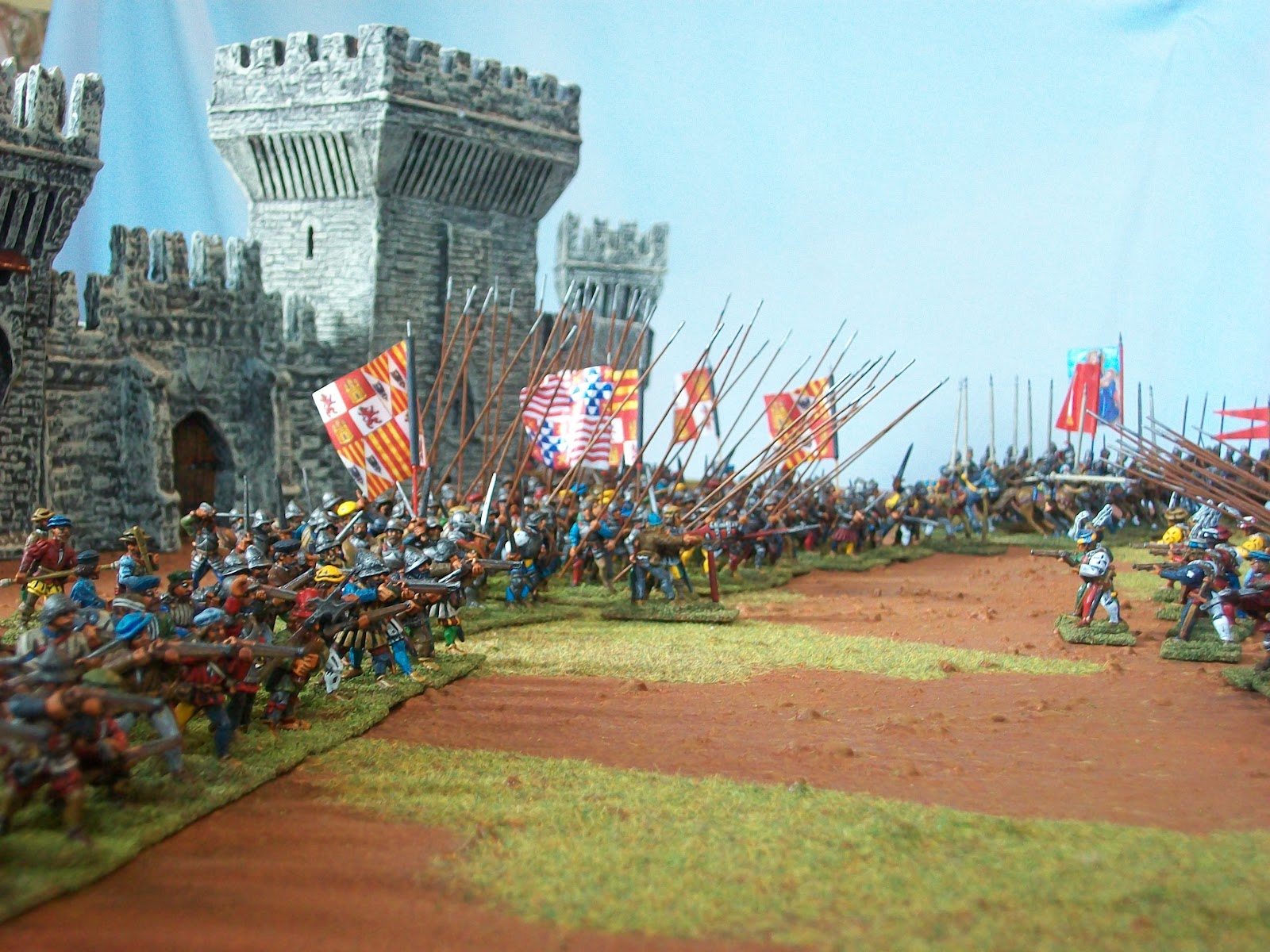
The below photos are of another set up. I was keen to see what opposing armies I could muster for the early war of 1499-1504. This is them, the Spanish sallying from an Italian town to defend against the French.
 |
| Swiss pike attack the Spanish |
 |
| Clash between French and Spanish forces |
 |
| Clash between French and Spanish forces |
 |
| The French |
 |
| The Spanish |
 |
| Spanish pike defend against the Swiss Mercenaries |
 |
| Spanish defend the town |
 |
| The French attack |

 |
Perry Men at Arms as French Coustilliers
As I mentioned above I was keen to see how my converted Perry Men at Arms, http://camisado1500s.blogspot.co.uk/2012/07/italian-wars-light-horse.html , fitted in with the other figures. Here they are in support of some Foundry and Eureka miniatures Gendarmes. Ironically for the very early 1500s it is probably the Gendarmes which are a little anachronistic and the lighter supporting horse that are more accurate. Below is one of the well known sketches of Paul Dolstein c.1502, a landsknecht who campaigned in Northern Europe. Although a different theatre of war it still shows that some of the horsemen at this time looked quite "medieval" in terms of arms and armour. I initially thought that the Eureka Archer figures depicting the lighter troops who fought on horseback with the Gendarmes were a little later than 1499-1504. and as such I did not include them in this set up. I had a look at some of the primary sources that they are based on such as Dürer's sketch of a mounted horseman, shown in my post linked above, and the two wings of the Paumgartner Altarpiece, shown below. As both these sources are dated from the very beginning of the 16th century it seems they would definitely be suitable. I have included a photo of the Eureka figures so you can see simliarity with the Dürer pictures. It seems armies of this period would be a mix of more medieval looking armour along with renaissance styles of clothing and armour.
|
 |
| Paul Dolsteins drawing of a clash c.1502 |
 |
| Albrecht Dürer's Paumgartner altarpiece c.1500 |
 |
| Eureka "Archers" with Imperial Banners |
 |
| French Gendarmes and Support |
The below photo, which annoyingly is a little out of focus, is of a troop of Italian Horsemen. All the figures are by the Assault Group, some are Italian Elemti and the rest are from their renaissance Spanish range. I really like these figures and find they give a really good feel for the period as they don't look like medieval knights and yet they have not quite reached the flamboyance of the Gendarmes.
 |
| Colonna Men at Arms |
 |
| Gascon Crossbowmen and Italian Mercenaries |
The above and below photos are of Assault Group and Perry Miniatures figures. When I want to create specifically Italian looking infantry I will mix in the miniatures from the new Perry Condottieri range with these. With the wide variety of head gear and clothing I really like these figures and find them suitable for about 1490 through to the 1510s.
 |
| Gacon Crossbowmen and Italian Mercenaries |
 |
| Reisläufer |
The final photos are of my
Reisläufer. The figures are mainly by Artizan. I think they are more suitable for the ealier Italian wars than the Landsknechts Artizan make. The clothing of the Reisläufer Artizan figures is deliberately of a simpler style than their Landsknechts. The below contemporary picture of the Battle of Dornach in 1499 where the Swiss defeated the Swabian League is a good example of how these mercenaries would have looked at the turn of the century. The big hats and big plumes of feathers are already in evidence (have a look at the banner bearer in the top left hand corner for the feathered head dress). The picture is also worth noting for the armour the horsemen are wearing, they still look very much like medieval knights.
As you can probably tell from this post I have been taking a second look at how the styles changed in this period. I have been going through my book collection, J R Hales "
Artists and Warfare in the Renaissance" is particulary good, and having a look on the internet. The problem is the more I look into it the more confusing things become. The styles change rapidly. Below is a picture of some landsknechts (and possibly a stradiot?) by Dürer c.1500. The figures look distinctively like landsknechts yet they also look distinctively different from the slightly later Landsknecht styles with the huge puffed sleaves and leather jerkins of the 1520s and 1530s. Another thing I have learnt is that a lot of artists lifted motifs and images directly from older works and incorporated them directly into their compositions. This would mean that although the picture may be from a later date some of the images in the picture may not be. Sometimes they kept the poses of the figures they lifted and updated the clothing but not always. Its pretty confusing! On the plus side however there is an abundance of pictures for the era which is great. They are great inspiration for collecting the armies.
 |
| Dornach c.1499 |
 |
| Albrecht Dürer's Landsknechts c.1500 |
 |
| Reisläufer |