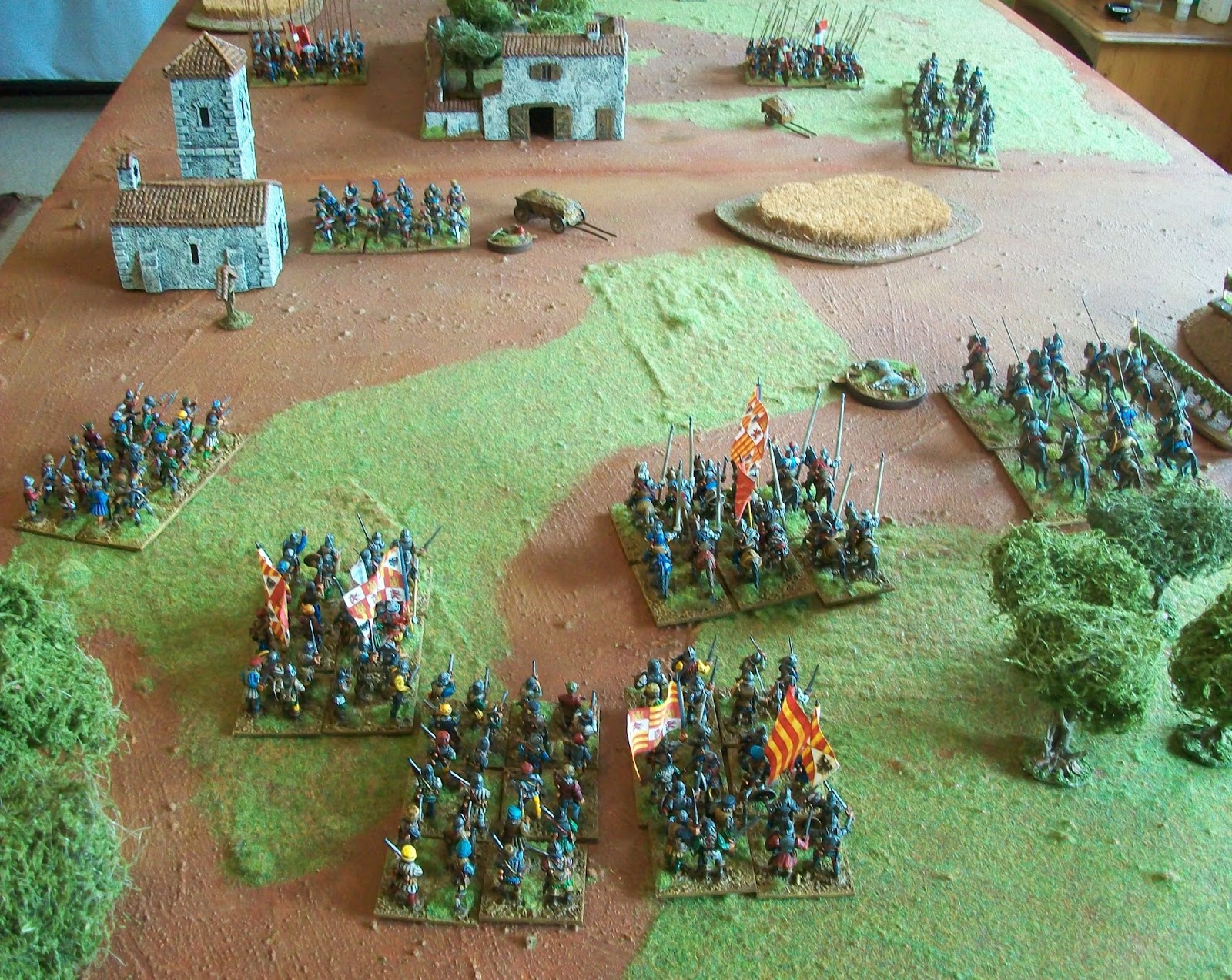
At the start of last month Stuart of Army Royal, http://stuartsworkbench.blogspot.co.uk/ , visited me and we continued our clashes set in Northern France 1513. We had a mammoth gaming session over three days playing four different scenarios and using the Lion Rampant 16th Century rules that Stuart has been developing, with some occasional suggestions from me. It was great fun and I think we really made some progress on rules for mounted longbowmen and the use of artillery in the skirmishes.
I didn't record exactly what happened in each game as it would have been a nightmare and slowed everything down. For example the second game we played was quite complex and involved relief forces for both armies joining the game later on under new captains. Recording everything that happened in that game alone would have been a big task. I did take lots of photos though, so I have decided a brief summary of each game and then some photos should be enough to give a flavour of them. As in previous games the pictures weren't posed and the light wasn't always great, especially as a couple of the games went on quite late, so apologies in advance for this. It's a picture heavy post but they were great clashes and I wanted to post up as many images as I could.
 |
| The start of the "Convoy" scenario with the French Mounted Crossbowmen attacking the convoy while the English Border Horse attempt to outflank them. |
The Convoy
For our first game we wanted something we could jump straight into as a bit of a warm up and to get familiar with the rules again so we decided to play the "Convoy" scenario that I had played through before: http://camisado1500s.blogspot.co.uk/2017/07/the-convoy.html . The only slight differences were that we substituted one of the French Ordonnance Archers armed with Lances units for French Ordonnance Mounted Archers and that we played with units of twelve or six figures rather than scaling up, although this figure numbers change had no impact on the actual game.
I think I had a bit of an unfair advantage in this one, having already played through the scenario before. Stuart took the French, keen to give his new Mounted Archers an outing and I played the English. I remembered that when I played it before the Burgundian Men-at-Arms, the most expensive unit for the English, had performed appallingly. This time I made sure they led the English convoy through, no matter how many bad activation roles they had! This led to the English managing to steam roll their way through the French and getting the convoy to safety, a very different result from the first run through of the scenario.
 |
| The English convoy heads into the teeth of the French ambush. |
 |
| The Stradiots are warded off by the English Archers. |
 |
| The English and French cavalry prepare to engage. |
 |
| The same scene as above but from the French lines. |
 |
| The English Border Horse and Demilancers attack the French. |
 |
| The French Gendarmes charge the English Pike, in the rules they were the same as Billmen, escorting one of the Wagons. |
 |
| Ardres - 1513, the Manor House objective is on the left, the Town Hall in the centre foreground and the Church is on the right. |
Ardres 1513
This was the game of the weekend, a real epic! It was based on the fact that during Henry VIIIs march to Therouanne in his 1513 campaign the Landsknechts in his pay attacked and looted Ardres followed by some of the English in Henry's army. We had a French Garrison in Ardres for our game - although as it was actually part of the English Pale at this date I doubt this would have been the case in reality! I took the French for this one with Stuart as the English.
The idea was that the English and Landsknechts, under an unknown captain would attack the town which had a weak garrison, again under an unknown captain. Using the same rules as the "Sausages without Fire" scenario in Lion Rampant the English would have to set fire to four objectives. Three of these were within the town walls, the Church, the Manor House (big building with a red roof) and the Town Hall ( another big building with a double roof and two chimneys). All three of these can be seen in the photo above. The fourth objective was one of the corn fields that lay outside the walls.
The forces for the initial clash were as follows:
The "French" Garrison
Foot Knights (the Garrison Captain)
2 Units of Aventuriers with Crossbows
2 Units of Picard Infantry
Organ gun and crew
English Raiders
2 Units of Shire Billmen, one of these is the English Captains Unit.
2 Units of Shire Bow
1 Unit of Landsknecht Shot
1 Unit Landsknecht Halberdiers
1 Unit of Border Horse
 |
| A Wagon stops the gate from closing and allows marauding Landsknechts in English pay to storm the town. |
 |
| The civilians flee as the Landsknechts enter. |
Once an objective had been set alight each player would role every turn to see if a relief force would arrive. This would be on a 9+ on two dice for the first turn, 6+ the second, 3+ if they still hadn't on the third and then automatically if no relief had arrived by the fourth turn. The French relief force would arrive in the Orchard near the main town gates and the English relief force would arrive by a side entrance to the town in front of the corn fields. Both relief forces would be entirely separate retinues in the game and were entirely mounted.
French relief force
La Palice and his Gendarme Company with supporting Mercenaries:
Jacques Chabannes, La Palice and his Gendarmes
1 Unit of French Men at Arms
1 Unit of Ordonnance Mounted Archers
1 Unit of Ordonnance Archers with Lances
1 Unit of Stradiots
1 Unit of Mounted Crossbowmen
English relief force
Sir Rhys ap Thomas's retinue and accompanying Burgundian Auxiliaries:
Sir Rhys ap Thomas and his Demilancers
2 Units of Mounted Archers (we used my Border Horsemen for these two units)
1 Unit of Burgundians Men at Arms
1 Unit of Mounted Crossbowmen
The aim of the French relief force was to either prevent more of the town being destroyed or prevent the English from escaping if this had already been done. The English relief force had to either aid with the destruction or if this was already accomplished to aid the escape of the English forces.
 |
| The French garrison ready themselves in the streets. |
 |
| In the dense streets the Landsknechts emerge. |
This was a hell of a game. Initially the English forces stormed the town, the Landsknechts going in first followed by the English archers. There was a lot of street fighting within the town which, although not such a visual spectacle as a pitched battle, was really entertaining and made for some tricky decisions for both of us during the game. Oddly it reminded me of the WWII City fights I used to game as a kid with my awfully painted Eastern Front Collection!
Eventually the French Garrison were worn down and destroyed, only the French Garrison Captain survived having defeated the English Captain in a challenge near the town gates. The English archers had taken the town and set about setting fire to it. This led to the French arriving very quickly through the orchard by the gates. The English managed to block them from getting in through the main gates but the Stradiots and Mounted Archers rode around the town walls to engage the English relief force which arrived slightly later.
Using the difficult terrain of the corn fields the French Light Cavalry did a good job of harassing the English cavalry as they arrived. The Burgundian Auxiliaries, the Men at Arms and Crossbowmen, were defeated in the fields. The English did manage to get into the town via the side gate and then attempted to force their way out of the main gate with Sir Rhys ap Thomas leading the way. Unfortunately Sir Rhys was defeated in another challenge by La Palice, the French relief force Captain, and only some of the English mounted archers managed to get away.
There were some great moments in this game. The initial fighting between the garrison and the looters in the town was really tense with lots of hiding in alley ways and waiting for the right moment to pop out and shoot or charge. When I get round to rebasing my 1540s English I think the "Camisade of Boulogne" will definiteley have to be fought out in this manner. The two challenges between the retinue leaders were fun, especially as the dice were on my side for these! At one point the English archers in the town rolled a "blunder" and shot some of their own side which we thought represented the chaos of the looting and burning in the town really well. Much to my annoyance Stuart's English managed to hold the main gate of the town for ages which stopped me from getting in and stopping them from burning everything. The pictures below should give some indication of the flow of the game.
 |
| The French Garrison in Ardres prepare to fight off the Landsknechts. |
 |
| At the top of the photo the Landsknecht shot can be seen entering the town. |
 |
| Bitter fighting in the town streets. |
 |
| A French captain manages to order the Picard Pikemen into an organised "Schiltron" style formation before the Landsknechts charge in. |
 |
| The Landsknechts have put themselves in the line of fire from the garrisons organ gun! |
 |
| As the French Crossbowmen prepare to defend the gates they are outflanked by Landsknecht Arquebusiers who are already inside the town walls. |
 |
| Another nasty fight develops. |
 |
| Following the German mercenaries in English pay the English Archers enter the town to join the looting! |
 |
| The English leader is however defeated by the French Garrison Commander in a duel by the gates.... |
 |
| ....the wounded English Captain is carried back to his men. |
 |
| The English archers engage with the Picard Pikemen. |
 |
| As the English take control of Ardres a French relief force arrives through the orchard, they have been alerted by the burning buildings. |
 |
| The English Archers continue to loot and burn the town. |
 |
| Some of the French Cavalry attempt to enter the town while the other Cavalry.... |
 |
| .... the Archers and Stradiots, ride around the walls to see if there are more English. |
 |
| They find Sir Rhys ap Thomas, the English Captain, and some Burgundian Auxiliaries. |
 |
| As some of the English horsemen enter the town by a side gate the French skirmish with them. |
 |
| Sir Ryhs ap Thomas gets into Ardres and rides to the main gate only to be challenged by Jacques Chabannes, or de la Palice, who challenges him to combat and defeats the Welshman. |
 |
| The terrain on the table rearranged for our Calais game. |
Conspiracy in Calais
Having enjoyed the street fighting of the previous game so much, for our third clash we came up with a new scenario. The town set up now represented part of English Calais. The scenario we were playing was "The Messenger" from Lion Rampant. One force was a band English rebels and hired German mercenaries who were accompanying a priest through Calais. This was no ordinary priest however as he had a secret message for Richard de la Pole, the last White Rose, from conspirators in England who were plotting to lead a Yorkist rebellion and depose the usurping Tudor, Henry VIII.
The rebels cover had been blown however and a loyal English force, men from Sir Charles Brandon's retinue, had been alerted to the conspiracy and were heading back to Calais from the French Campaign to apprehend the messenger. The rebels had realised their cover was about to be blown and were trying to escape the town and Calais Pale for the safety of French territory before it was too late.
Stuart took the English for this and I played the rebels. The forces were as follows:
English from Sir Charles Brandon's Retinue
The Captain 1 Unit of Foot Knights
1 Unit of Garrison Bill
1 Unit of Garrison Bow
1 Unit of Mounted Archers (again we used some of my Border Horse for these)
1 Unit of Border Horse
The "Yorkist" Rebels
The Conspirators and Priest 1 Unit of Foot Knights
2 Units of Shire Bow
2 Units of Landsknecht Halberdiers
1 Unit of Landsknecht Shot
 |
| The English forces riding back to the town to stop the messenger reaching Richard de la Pole, the last White Rose! |
 |
| The Priest bearing the message is accompanied by a motley crew of English Rebel archers and mercenary Landsknechts. |
This game turned out to be a bit of a disaster for the rebels! They soon became trapped in the narrow streets of the town and subjected to archery from the Garrison Bow, the English Mounted Archers and the Border Horse. The rebel archers were truly atrocious at rolling for activation (of course I would blame the dice!) and were taken to pieces by the loyalist forces. The Conspirators did make a rush for the gates but the Rebel Captain was defeated by the Loyalist Captain (in a challenge if my memory serves me correctly). The priest nearly made it out but in the end he was contained within Calais and the conspiracy was crushed.
This was another great game where the street fighting was really nasty. There was a lot of archery in the alley ways and evasion by the English as the Landsknechts tried to get to grips with them. This game also showed how you can be flexible with Lion Rampant and play all sorts of interesting scenarios, in fact it's much better for these kind of games than for pitched battles. As the 1513 Tudor campaign in France only really had one pitched ""battle" which was more of a rout anyway I think Lion Rampant works well for the various raids and ambushes of the campaign.
 |
| The rebels hurriedly try to escape the town, knowing their cover has been blown. |
 |
| The plotters in the Church gardens. |
 |
| Men of Sir Charles Brandon's Retinue enter Calais to root out the plotters. |
 |
| English Archers in the Calais garrison shoot at the Landsknechts. |
 |
| The rebel forces become trapped in the narrow streets and fall prey to the superior archery of the garrisons bowmen. |
 |
| More English troops enter the town and although the priest does get to the gates he is apprehended and the plot is foiled! |
 |
| An English Bastion outside Therouanne is threatened by a sally from Landsknechts in the French Garrison. |
The Sally
Our final game was more of a test scenario to try out culverins, well breech loaders in this case, and organ guns. For this one we returned to the walls of Therouanne. It was a sally by Landsknechts in the French Garrison against an English Bastion which had been established as part of the siege works. I played the French, well Landsknechts in French pay, with Stuart taking the English. The forces were as follows:
The Landsknecht Sally
2 Units of Landsknecht Halberdiers (one is the Retinue Leader)
1 Unit of Landsknecht Shot
1 Breech Loading Gun (fixed on the walls)
1 Organ Gun
The English Besiegers
1 Unit of Shire Bill (The Retinue Leader)
1 Unit of Landsknecht Shot
1 Unit of Shire Bow
1 Breech Loading Gun (fixed in the earthworks)
1 Organ Gun
This game was another disastrous defeat for me! As my Landsknechts attempted to storm the English earthworks they were shot to pieces and the English had clearly won this clash outside the walls. It did allow us to trial some rules for the guns in which they can fire relatively easily to start with and then this becomes more and more difficult each time they fire. We felt this worked well as it allowed for guns to be used more that once but they cannot keep on firing rapidly. At first the breech loaders may have multiple charges ready which allows for a few shots that are not too difficult to achieve but after this as new charges have to be loaded and the gun has heated up it becomes more tricky to roll to activate and fire. This did require more record keeping but it seemed to work well.
I hope these write ups make sense. It can be tricky to remember everything and as I said above we didn't play these games as Battle Reports. They were all really great fun to play and I thought we came up with some very entertaining scenarios. Now we just have to think up some more! There has not been a chance to do much painting over the summer but there are new figures on the way. I have put together some of Stuarts Tudor dollies as English Archers and they should hopefully be finished within the next few weeks.
 |
| The Landsknechts sally out being supported by a gun on the walls and bringing an organ gun with them. |
 |
| The English have a gun mounted in the Bastion to suppress the French attack. |
 |
| The Landsknechts engage the English in the no-mans-land between the earthworks and the walls but are soon worn down by the English besiegers and defeated. |