Tuesday, 1 September 2015

A New Building.....


This post is basically just an excuse to show some pictures of a new (well newly painted) scenic item. Over the summer I had the chance to finish a project I started last November, painting up the fantastic Convent building that GrandManner make in resin http://www.grandmanner.co.uk/Convent_building--product--116.html . It was actually a fairly easy task, once it had been washed and all the excess resin trimmed off, although I am not entirely sure my painting skills have done it full justice. There was no way I was attempting stained glass windows or anything like that!
I will admit that I think the building it is based on was actually built in the early 17th century so there may be a little anachronism in the architectural stlyle! Despite this I really feel it looks the part for an Italian ecclesiastical building, be it an Abbey, Convent or Monastery. I have seen the same piece used in Medieval and Italian Wars games before at shows and I could not resist! It makes a great backdrop for the miniatures and also adds a certain depth to the photos that I wasn't expecting.
I have also had time to set up my full battlefield and of course had to take some photos of the new building with some miniatures. So below we have pictures of the early Italian Wars with a Spanish and Italian force arrayed in front of the Convent, the French and their Swiss mercenaries leading an assault.

The Spanish defend against a French Assault

Spanish and Italian Cavalry support the infantry block

Spanish and Italian Infantry

Italian Skirmishers engage the French

Italian Archers and Arquebusiers

The Church, Convent, Abbey or Monastery


Italian Archers in front of the Spanish Infantry

A view from the French lines


Spanish Jinetes

Spanish Jinetes

I was keen to see how the Perry Jinetes I converted a while ago fitted in to my Spanish Army and I am really pleased with the result. The Perry Light Cavalry kit allows for some very dynamic figures, I still have two more boxes to paint and feel another set of Jinetes may be the fate of one of them. They were certainly a mainstay of the Spanish armies in the early phases of the Italian Wars.
One of my favourite things when collecting this era is the mixing of late medieval and early renaissance figures. The pictures below show this well. They represent French Gendarmes (who don't seem to have had time to put on any barding!) for around 1500. A mix of late 15th and early 16th century Harnesses with the lighter equipped "archers" making up the supporting rank for the Gendarmes. There are Foundry, Perry, Assault Group and Eureka miniatures all mixed together and I love the result. No fully slashed clothing or Gendarmes in the style of Maximilians Triumph quite yet. I am tempted to get some of the Mirliton Condottieri to add to this mix, they have some particularly impressive helmet crests that may be a little more 15th century but certainly wouldn't look out of place in the early Italian Wars.

French Gendarmes c.1500

French Gendarmes

French Gendarmes

French Gendarmes

Swiss Pike Block c.1500

Tuesday, 25 August 2015

Early Italian Wars Command Base


This is just a quick post to show my first attempt at a round command vignette. One of my reasons for rebasing the collection was that it allows for this kind of little diorama, I am currently working on a couple more. I wanted some figures who could represent commanders for the early part of the Italian Wars from around 1495 to 1515. There are plenty of good Landsknecht and Gendarme command figures but these are generally for a little later. Italian Condottieri Captains are also available but they tend to be more for the late 15th Century, although saying that some may well creep into the collection at some point!
I had a couple of old Wargames Foundry figures, in fact two of my old favourites that led me to collecting Wars of the Roses armies in 25mm years ago. They are in the first set here: http://www.wargamesfoundry.com/medieval/wars-roses/infantry . I thought they were too good not to have a spot in the collection so they have had their heads swapped and the ever useful Perry Tudor heads have replaced them. I do feel the Captain at the front does look like he has a bit of a "no neck" issue and I am not sure why I chose the ugliest possible Perry head for his armoured advisor! Despite these minor points they are great for Spanish, French or Italian Captains of the early Italian Wars. Here they are shown with one of Petes excellent flags representing the banner of Pietro Marquis Bourbon del Monte Sante Maria, which was captured when he fought for the Venetians in 1509 at the Battle of Agnadello, http://thegreatitalianwars.blogspot.co.uk/2013/07/battke-of-agnadello-1509.html. The flag is interchangeable with my other banners so they could represent another leader with a simple change of the banner. Behind the old Foundry Men at Arms are three figures from The Assault Group representing the trumpeter, standard bearer and guard.
The dogs are from Simon at Je Lay Emprins, http://je-lay-emprins.blogspot.co.uk/2014/06/release-hounds.html. They are fantastic little miniatures and really add to the scene. I only have a few and have been dithering on when to commit them to a base! Stuart at Army Royal also very kindly sent me a couple of these hounds so I have a few yet to use. I think the others will accompany mounted commanders, I just need to find some suitably grand mounted figures!

Command group carrying a Venetian Flag from the Battle of Agnadello 1509

The Trumpeter awaits instructions to send out orders

Saturday, 1 August 2015

Longbows/Warbows in the early 1500s


The Longbow or Warbow seems to always generate quite a lot of historical debate, even whether to call it a Longbow or not has caused argument! I have been interested in it's use in the early 1500s and was keen to paint up some figures armed with bows for my collection. Whenever you read about the campaigns of this era there are mentions of archers, but often little discussion of how they were deployed or what they looked like. Stuart has recently finished some of his spectacular French Ordonnance Archers over on Army Royal:  http://stuartsworkbench.blogspot.co.uk/2015/07/ordonnance-archers-complete.html and has also written up a great piece discussing them: http://stuartsworkbench.blogspot.co.uk/2014/12/ordonnance-archers-wip-part-1.html . 
The French and the English are the obvious armies where these kind of troops would be deployed but I have also come across references to them appearing in other forces. De Gaury's "The Grand Captain", for example, mentions Gonzalo de Cordoba having two regiments of Basque Archers under his command when he was tasked with dividing up Naples between the French and the Spanish in 1501. Now this is a dated work, published in 1955, and certainly not up to the standards of historical writing today but it is interesting to think that the Spanish may have fielded these troops. This is a complete guess but if the Spanish did field Basque Archers, as the Basque Country is in Northern Spain I would assume they were more likely to be men carrying the Longbow/Warbow rather than the smaller recurved bow popular in the Mediterranean. David Nicolle in the Fornovo Osprey book mentions Italian infantry in the 1490s called arceri who were modelled on the English Longbowmen. I think this is the only reference to these type of troops in Italian Armies that I have come across.
What further interested me was when I had a closer look at images from the Wiesskunig, the book Holy Roman Emperor Maximilian I had commissioned to chronicle his life and depict him as a paragon of Chivalry. It was completed in the mid 1510s and interestingly has quite a few depictions of archers, which I have posted below. The archers are shown being transported in a ship as part of the Imperial army and in combat in four of the woodcuts. In two of these combat scenes it looks like they represent the English at the Battle of the Spurs in 1513 when Henry VIII and Maximilian's forces routed some French cavalry. The two images below these I am not so sure of, unfortunately I don't know the full story of the Wiesskunig although I am aware it follows Maximilian's historic adventures but gives them a gloss in which he always comes out looking great! He was very keen on his propaganda after all. What is particularly odd is that in the last combat woodcut both armies are fielding archers who are dressed in the Landsknecht style. This is unusual as normally in the woodcuts they are depicted in long coats. I would be keen to know what is being represented here although it may not be an actual historical event. The final two images from the Wiesskunig show the archers more as guards, they can clearly be seen watching the grisly beheadings (the Wiesskunig is very keen on showing this kind of thing!) and then as part of a royal bodyguard in the final image. Maximilian's father in law Charles the Bold had chosen archers as his royal bodyguard as of course did the French Kings.

Image from the Wiesskunig showing archers being transported in a ship

Image from the Wiesskunig depicting acrhers in battle, I think this depicts the English archers at the Battle of the Spurs in 1513.

Archers follow up the Men at Arms, as they accompany Billmen I would guess these are also English. Note the sword and bucklers they carry.

Archers face charging Men at Arms in the top left of the this image from the Wiesskunig

Archers are depicted in Landsknecht style clothes in this rather curious scene from the Wiesskunig

Archers watch and guard a series rather grisly ship board beheadings

In this scene from the Wiesskunig the bows of the archers can be seen in the background, it looks as though they are part of  Maximilian's bodyguard

So where am I going with this ramble on archers in the early 1500s? I have always been a fan of the old citadel Empire range that the Perrys sculpted back in the 1990s. Over the years I have slowly picked up a sizeable force of the bowmen from this range on Ebay. This was made much easier when I learnt how to strip old painted figures of paint with Dettol so they look like new. You can pick up the old clogged figures pretty cheaply while the unpainted ones can be expensive. Some of these figures were in my old Tudor army, most of which has now been sold, and are shown in their previous incarnation below. I spent ages trying to decide whether to do them all as English archers but in the end decided against this, mainly for the reasons above, that it seems archers with the Longbow/Warbow were fielded by other nations in the early 16th century. I wanted a group that could be used to depict the English (ok so they should really be wearing the red St Georges cross even if they are not uniformed) or dismounted French Ordonnance Archers or archers in the pay of Maximilian. For this reason I have painted them in different coloured coats rather than in any particular liveries. I think once an English swallow tailed banner, a Red and Yellow banner of Louis XII or a Hapsburg saltire is seen flying above them they will look convincing, the long coats certainly look the part. I am not sure they could pass muster as the Basque archers or Italian arceri however!
A few things have been done to the figures. The Perrys sculpted 6 poses in the long coats so for variation I have changed hairstyles and added some beards with green stuff. I have also made a number of headswaps. This was a bit of a nightmare as I thought I would easily be able to add Perry Tudor heads or heads from their Wars of the Roses plastic sets. This doesn't work as they are big figures, about the size of Front Rank figures to give an idea. Adding Perry heads just did not look right so in the end I had to get back on Ebay and pick up some old plastic Empire heads from Citadel. These fitted much better although I did do some further converting of them. A lot of the plastic empire heads and the original heads of these figures are wearing a Landsknecht style skull cap either on its own or under another hat. While I didn't mind a few of these I certainly didn't want a whole load of archers in them so they were removed or long hair was modeled over them.
The original Citadel figures did not carry any side arms so all the figures have had plastic swords or swords and bucklers added from the Perry late medieval kits. One of the woodcuts above shows an archer carrying a sword and buckler. The addition of the swords really helps the figures look more three dimensional as well, the swords break up the rather stiff poses of them all leaning or shooting forward. The figures all already wear archers bracers and have the arrows tucked in their belts so there was no need to do any further converting.
I also had a bit of a basing disaster. Initially I thought they should be the same as the crossbowmen and arquebusiers that I have based in closer order, four to a base. I glued them all to the bases like this and added all the gravel only to realise the next day that they were way too close together, none of them would have been able to loose any arrows! As mentioned before they are big miniatures. So in the end they ended up three to a 45mm by 45mm base and I think this looks about right.
So here they are, thirty figures on 10 bases that could represent English from the Calais Garrison or an invasion force, English in Imperial pay, dismounted French Ordonnance archers or even Scots Archers of the French Royal Guard who have become bedraggled and non-uniformed on campaign. I would say they fit for around 1500-1530, although I suppose the 1510s is when they are most accurate for. I already have some more generic command bases that could go with them and will probably work on a few more. I think they need a flag to fight under and am quite keen to see what they look like under a swallow tailed English flag.

An earlier attempt at these figures, I painted them up to represent archers in Henry VIII's army of 1513.

The archers

A close up of some of the archers

A picture from the back showing the long coats and the addition of the plastic swords

One of the archer bases, the two figures on either side have had headswaps

Another base, the closest figure has had a feather added to his hat and the two figures behind have had beards modeled on with greenstuff

Tuesday, 14 July 2015

Fähnlein


There aren't really enough Landsknechts in this block to constitute a real Fähnlein, certainly not a full strength one, but I could not resist posting up some photos of the massed Landsknechts now they have been rebased. The previous giant block, http://camisado1500s.blogspot.co.uk/2011/07/forest-of-pikes.html, was 256 figures. The new block totals a terrifying 292 figures (terrifying when I think how long each figure took me to paint, I could probably have done a PhD in the time it took to paint this lot!). Despite there being more figures I think it takes up less space than the other block as they are based much closer together now. There are 14 ranks of 21 figures each, 49 bases of 6 figures per base. A couple of the command bases have 5 instead of 6 figures so there are 292 miniatures in total.
Lest the Landsknechts take all the glory I also had a chance to form up my Reisläufer block for the first time since I have rebased them. It's 118 figures in all, 10 ranks of 12, but again the command bases only have 5 figures. Although the Artizan Reisläufer figures have simply been painted up, the Old Glory and Foundry figures have had a lot of conversions done to really give this block a different feel from their professional competitors the Landsknechts.
If the Landsknecht block will get any larger remains to be seen. I suppose it depends if anyone makes any more 28mm Landsknechts and I am still hoping that one day a manufacturer will make some suitable for around 1495-1505 that will fit well with my really early Italian Wars stuff. You can never have enough of these colourful chaps in a 16th century army!

The front of the Landsknecht Pike Block

Arquebusiers skirmish in front of the pike

Skirmish screen of Landskencht arquebusiers

The pike block from the side

Landsknecht Pike

The back of the block

From above


Reisläufer

Swiss pikemen

Swiss pike block

Saturday, 4 July 2015

Perry Light Cavalry - Jinetes


Jinetes were the Spanish light cavalry who used tactics developed from centuries of fighting the Moors in Spain during the Reconquista. Converting a set out of the Perry Plastics has been a project I have wanted to do for ages. Originally I was going to convert them from the Men at Arms plastic set, as I did with my lighter cavalry, but when I found out the Perrys were working on a specific set of light cavalry for the late 15th century I decided to wait for these. There is not really that much conversion work in the figures in all honesty but a few little changes have been done to make them look like Jinetes. One thing I will note is that I think Jinetes actually rode their horses in quite a different style from Western European cavalry in the late middle ages. While these figures ride with their legs nearly straight, Jinetes would have ridden with shorter stirrups and bent knees. When working on these I also picked up some inspiration from Miguel's awesome work on "Wars in Miniature", http://warsinminiature.blogspot.co.uk/2014/03/nuevo-proyecto-guerra-de-granada.html.
The first obvious thing about the figures is that they carry the typical Moorish leather shields, Adargas, while a few carry bucklers. The ones I used are from Redoubt Enterprises and Wargames Foundry and they really help to change the style of the figures. I have left some as undecorated leather while others are painted.
The horses have also had some green stuff added to change the trappings on some and alter the saddles on others. I feel this gives a more Spanish/Moorish flavour to the figures and was also a good chance for me to experiment a bit more with the dreaded green stuff. This was also used to give all the figures (whose faces can be seen) beards and/or long hair. I am definitely improving with the green stuff in this regard and it took me surprisingly little time to model these features on. I am not sure my photos are good enough to really show this but I hope some of the close up photos below will do the hair styling some justice!
I did think about javelins, their most famous weapon, and even bought some javelins in holders from Essex Miniatures. I decided not to use them in the end as I have not seen any contemporary images of Jinetes holding javelins in holders. I may do another set, as I have 2 more Perry plastics boxed sets of cavalry, and try putting javelins in their shield hands. I know they were meant to be expert horsemen but you do wonder how easy it was to ride with a arm holding a shield and a couple of spare javelins! 
Despite the lack of javelins I think the changes really help to give a distinctive feel to the figures. I reckon these figures could be used in Spanish armies from Ferdinand and Isabella's conquest of Granada that started in the 1480s all the way up to Italy in the early 1520s at a pinch.

Jinetes

Spanish Jinetes


Jinetes with Moorish influence

With the above figure on the left I wanted to include a turban as I like the idea that some of the Granadians would have continued with traditional styles of dress and this would be reflected in the Spanish armies. I was also influenced by the below painting by Vincenzo Catena in the National Gallery. The kneeling figure has European armour but wears a turban and his horse has trappings from Islamic Spain. I would hazard a guess that the artist may possibly have been influenced by Jinetes when painting this? If I do another set of Jinetes I think I will include a few more turbans as they also help to give a distinctive character to the horsemen.

"A Warrior adoring the Infant Christ and the Virgin", Vincenzo Catena 1520s.

Jinetes with adargas

Converted saddles

Captain and Trumpeter

While on a Spanish vibe I was lucky enough to spend last weekend visiting Granada with my brother. It was a fantastic trip with fantastic weather, tapas and probably a few too many cervezas, but it was a holiday! I joined the massed ranks of tourists to visit the Alhambra and although it was busy and we were herded around by our tour guide (who was actually very good) it really is a must see. I was amused that Charles V had put an enormous Italian Renaissance style palace (that was never finished) right in the middle of the place! He has also added his imperial eagle and motto "Plus Ultra" into many parts of the Islamic Palaces which is slightly incongruous as well. The 14th and 15th century Islamic parts of the complex are breathtaking, really like something I have never seen before. If you do visit you really need to book as far in advance as possible as the amount of visitors a day is strictly limited.
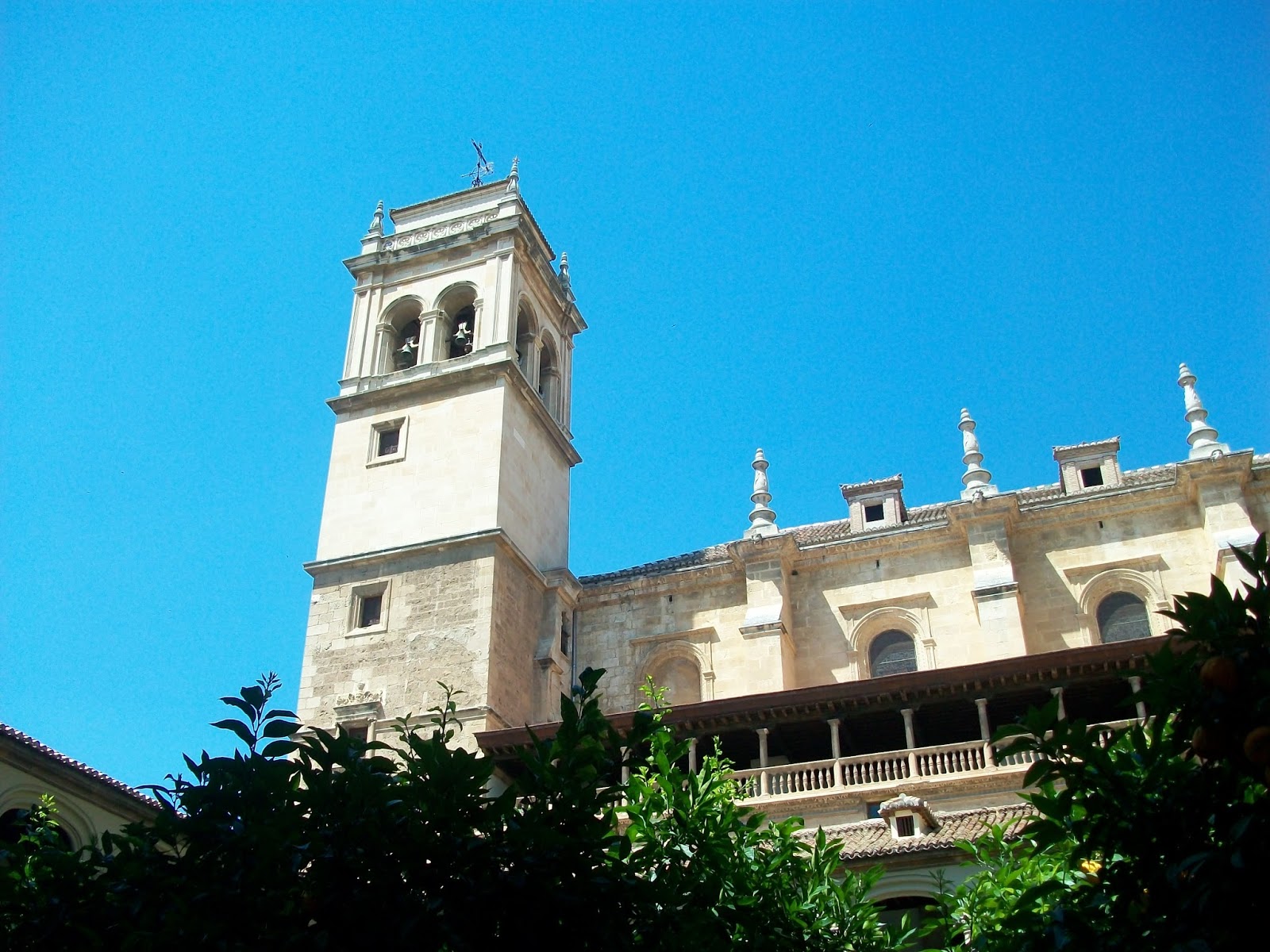
While in Granada I also made a pilgrimage to the much quieter Monastery of Saint Jerome, my brother and I were the only people in the enormous church which was silent and cool despite a scorching day outside. The reason we visited was to see the tomb of Gonzalo de Cordoba. Anyone who has read this blog for a while will know that one of the parts of the Italian Wars that fascinates me most is Gonzalo's campaigns in Naples at the turn of the fifteenth century, culminating in the battles of Cerignola and Garigliano in 1503. His grave is a suprisingly simple marble slab, shown below. Apparently there was once a great tomb covered in momentos of his victories but this was destroyed during the French occupation of Granada in the 1800s. I also visited the tombs of Ferdinand and Isabella in the Royal Chapel of the Cathedral (the trip wasn't as morbid as I am making it sound!) where they had some original flags from the conquest of Granada which 
were amazing to see but unfortunately photos weren't allowed in there. It is a great place to visit for anyone interested in the renaissance.

The Alhambra

Monastery of Saint Jerome, Granada

Tomb of "El Gran Capitan", Gonzalo Fernandez de Cordoba