After working on the merchant ship earlier this year (see
http://camisado1500s.blogspot.com/2023/01/a-merchant-ship.html) the temptation to find an early 16th century ship better equipped for war has proven too great! Whilst various later medieval boats are available there aren't really many suitable for the first half of the 1500s. Searching the internet led me to this 3D print file, which was only $7.50,
https://www.cgtrader.com/3d-print-models/miniatures/architecture/merchant-ship-tabletop-terrain-28-mm and I thought it was worth picking up just in case I could find someone that could print it. I contacted a few companies but they were daunted by the sheer size of the model. Through a mutual friend I was then introduced to a local chap named Ben who was keen to test the abilities of his newly constructed 3D printer, I just needed to pay for the cost of the materials.
Ben did a fantastic job, managing to print the ship in chunks that would fit the printer and could then be assembled as if much of it had been printed as one piece. If you look at the images on the link to the file above you will see that the original model has sails. I didn't really want the sails to be replicated on this vessel. Ben cleverly removed these in the printing process so the booms or spars (I am not great on nautical terminology!) then just had to be cleaned up so my own furled sails could be attached using the same method as for the previous ship.
 |
| The Mary Rose from the Anthony Roll of the 1540s. The model ship does not have exactly the same shape but it is not far off. |
 |
| Embarkation of Henry VIII at Dover - The painting depicts Henry's embarkation to sail from Dover to Calais in 1520, in order to meet Francis I at the Field of the Cloth of Gold. It is dated from 1520 to 1540. |
 |
| Detail from the Embarkation of Henry VIII shown in full above. Note the shields that line the ship as well as those surrounding the crow's nests. I have tried to replicate this on the model ship. |
 |
| Carracks clashing in a depiction of the Battle of Zonchio between the Venetians and Ottomans in 1499. As with the above image note all the shields that line the ships. |
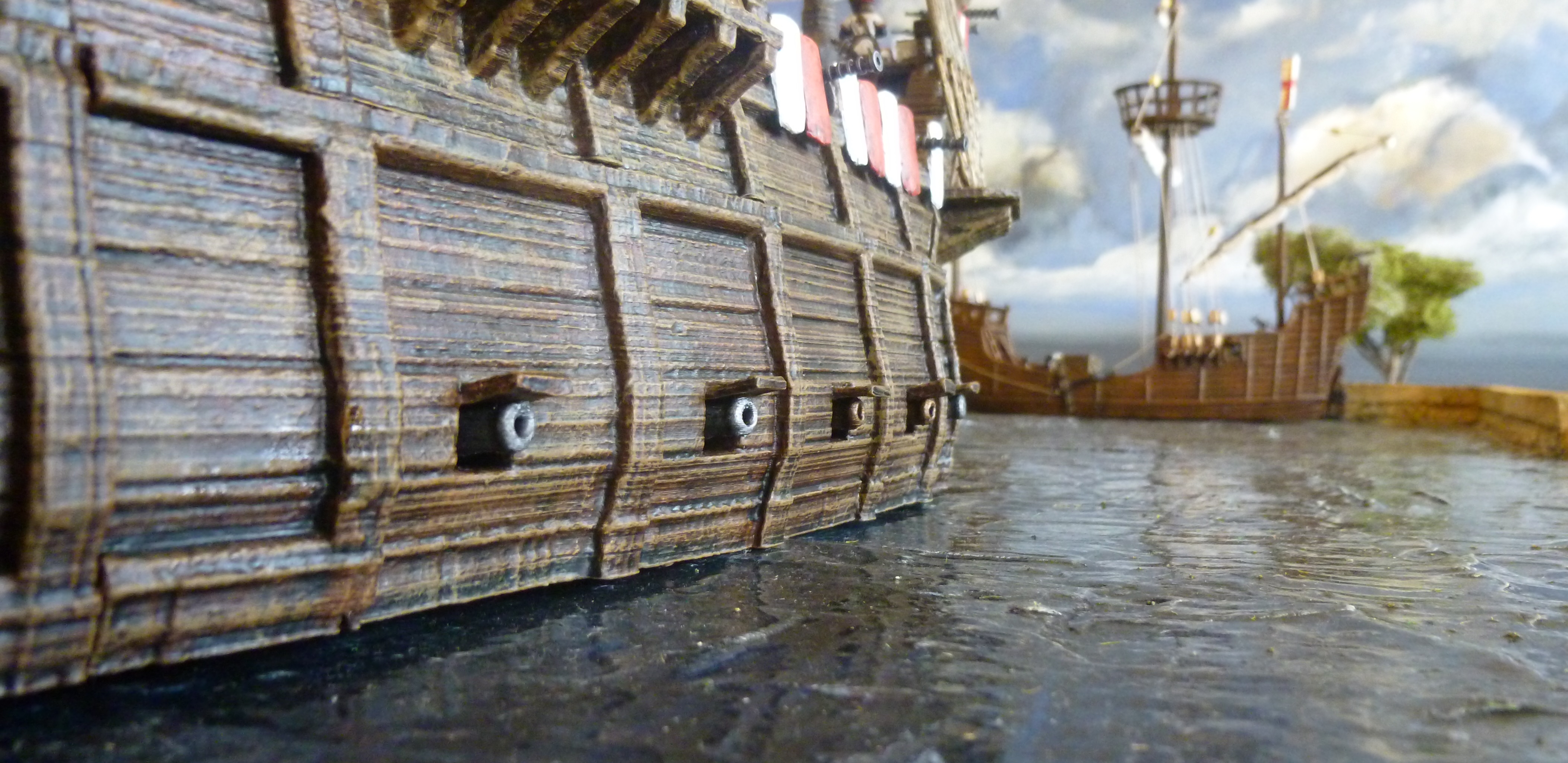
The shape of this 3D ship matches contemporary images of early 1500s carracks fairly closely (see the images above). There a some odd things about the model. I have no idea why a rudder is not modelled on, but could always add something for this later. The lower gun ports did not have hatches so I made a mould with siligum using a hatch from the smaller model ship and over a couple of weeks made all the hatches from green stuff. The same method was also used to replace the windows of the aftcastle with further gun ports. For more detailed 3D printing Fire Storm games were really helpful and printed out loads of swivel guns from this set
https://cults3d.com/en/3d-model/game/european-light-artillery-pack. These were then used on the side of the boat and also for some of the barrels poking out of the upper decks.
The ship is meant to represent a large merchant vessel that has been prepared for war. The gun ports are one way this is represented whilst the addition of the shields or pavises is the other. Have a look at all of the images above and it is clear that these ships were covered in these pavises when going to war. The detail from the "
Embarkation of Henry VIII at Dover" clearly shows them all along the decks and surrounding the crow's nests as well. I was torn when it came to these shields as the ship would've looked spectacular if they had all been in Tudor colours, with roses, St Georges crosses and portcullis adorning them. This would have limited the use of the ship on the gaming table though. The flags on the top are interchangeable so with a simple swap it can become a Scots, French or Venetian vessel. For this reason I went with the simple red and white colour scheme. Initially it was painted in red, yellow and white but when it started to look like a "McDonalds" ship this was quickly changed!
The other reason for simply painting the pavises in red and white is that there are 93 of them. Most are plastic ones from lots of sprues of Perry medieval plastics but some metal ones were needed to make up the numbers. In total there are 36 guns, 14 of which are heavier cannons, the other 22 being lighter guns or swivel guns. For the crew in the photos below it is filled with 1540s Assault Group and Petes Flag miniatures. These will be based up later for units in my collection. I am keen to paint up some more suitable crew figures but whilst there are crew models for the Elizabethan period I am not sure of any particularly good ones for the earlier part of the century. Maybe renaissance gun crews would be a good place to look for suitable figures?
As with the first merchant ship this will be useful for lots of scenarios and naval landings, anything from James IV subduing the islemen and highlanders on the Scottish west coast through to the Venetians landing troops to attack Ottoman positions in the Mediterranean. Below are lots of photos of the ship and the troops on deck. Of course now I have this miniature a big refight of Pinkie is definitely going to have to happen!
 |
| A Tudor Warship. |
 |
| Note quite the Mary Rose in 28mm but it's not too far off! |
 |
| A view of the vessel from the shore. |
 |
| Note the three tiers of gun ports. |
 |
| A view from the bow. |
 |
| The war ship and the smaller merchant carrack. |
 |
| A view from the stern. |
 |
| Note the bronze cannons in the aftcastle. |
 |
| A view of the warship from above. |
 |
| A Tudor warship in 28mm. |
 |
| A view of the soldiers manning the crow's nest. |
 |
| The crow's nests are protected by shields. |
 |
| The main deck. |
 |
| The figures manning the deck are mainly 28mm Tudor figures from the Assault Group with a couple from Pete's Flags also on deck. All the flags used are from Pete's Flags. |
 |
| The ship is armed with swivel or "base" guns. |
 |
| Tudor arquebusiers man the decks. |
 |
| The Captain and his officers. |
 |
| The Captain leads from the aftcastle. |
 |
| The ships command. |
 |
| A Tudor Warship in 28mm. |
 |
| A view of the aftcastle. |
 |
| Larger cannon on the gun deck. The hatches were made out of green stuff. |
 |
| In total the ship has 36 guns on it, not including the figures carrying arquebuses. |
 |
| A view of some of the guns in the stern. |
 |
| A view of the formidable array of guns! |