Monday, 1 February 2021

Pieve di Cadore, 1508


Following on from my Cerignola refight I was keen to try another Italian Wars battle. So here we have Pieve di Cadore (also Pieve de Cadore or Cadore). I liked the idea of an Italian Wars battle in the snow and the fact I could use my landsknecht and Venetians. It didn't really go to plan for a couple of reasons. Firstly whilst I have chosen some photos for this write up about 90% of them were unusable. The white background just made the figures too dark and it didn't work at all. Secondly when I played through the game it went even better for the Venetians than the historical battle! A total rout of the Germans with them never clashing with the main body of Venetian infantry who were blocking their escape. As a result the write up of the actual game is fairly brief.

Pieve de Cadore, 1508

On 29th April 1507 the French king Louis XII entered Genoa in triumph having threatened it with a powerful army. With Louis also being the ruler of Milan the French were now dominant in northern Italy. This was not to the liking of Maximilian I, nominal ruler of the Hoy Roman Empire, who did not want the French closing in on yet another of his borders. In an Imperial diet at Constance Maximilian attempted to raise the funds to invade Italy, assert his Imperial rights and be crowned Emperor. The funds for 12,000 men were raised but Maximilian knew this was not enough to challenge the French.

Not wishing to pass up the opportunity of the money raised Maximilian changed his target from the French to the Venetians. He used the fact they had refused to ally with him against France as well as repeatedly refusing him passage through their territory as a pretext for a war which he hoped would expand the Habsburg territories. In February 1508 his troops began to invade Venetian territory. Despite the snow a diversionary force of around 4,000 German infantry under Paul Sixt I von Trautson invaded the Cadore region of the Dolomites. On hearing reports of this the Condottiere Captain Bartolomeo d'Alviano with a few hundred men at arms and light cavalry and a couple of thousand infantry under Pietro Monte moved over the mountain passes in an attempt to cut this force off.

On 2 March, as the Venetians drew near, the Germans attempted to retreat, adopting a formation with their baggage and camp followers in the centre of an infantry square. D'Alviano's light cavalry,  consisting of mounted crossbowmen and stradiots, held up the Germans, allowing Pietro Monte's infantry to take up a position at a dry stream bed outside Pieve di Cadore and block the German retreat. Sixt von Trautson was slain, reputedly in a duel with Rinieri della Sassetta a Venetian standard bearer (although confusingly I have also read that he was beheaded shortly after the battle) and two thirds of his force failed to escape. A grateful Venetian republic richly rewarded d'Alviano, giving him some of the captured German artillery pieces. Maximilian's main force, heading for Verona, was blocked by d'Alviano's cousin, Niccolo Orsini da Pitigliano and the Habsburg ruler was forced into a humiliating retreat.

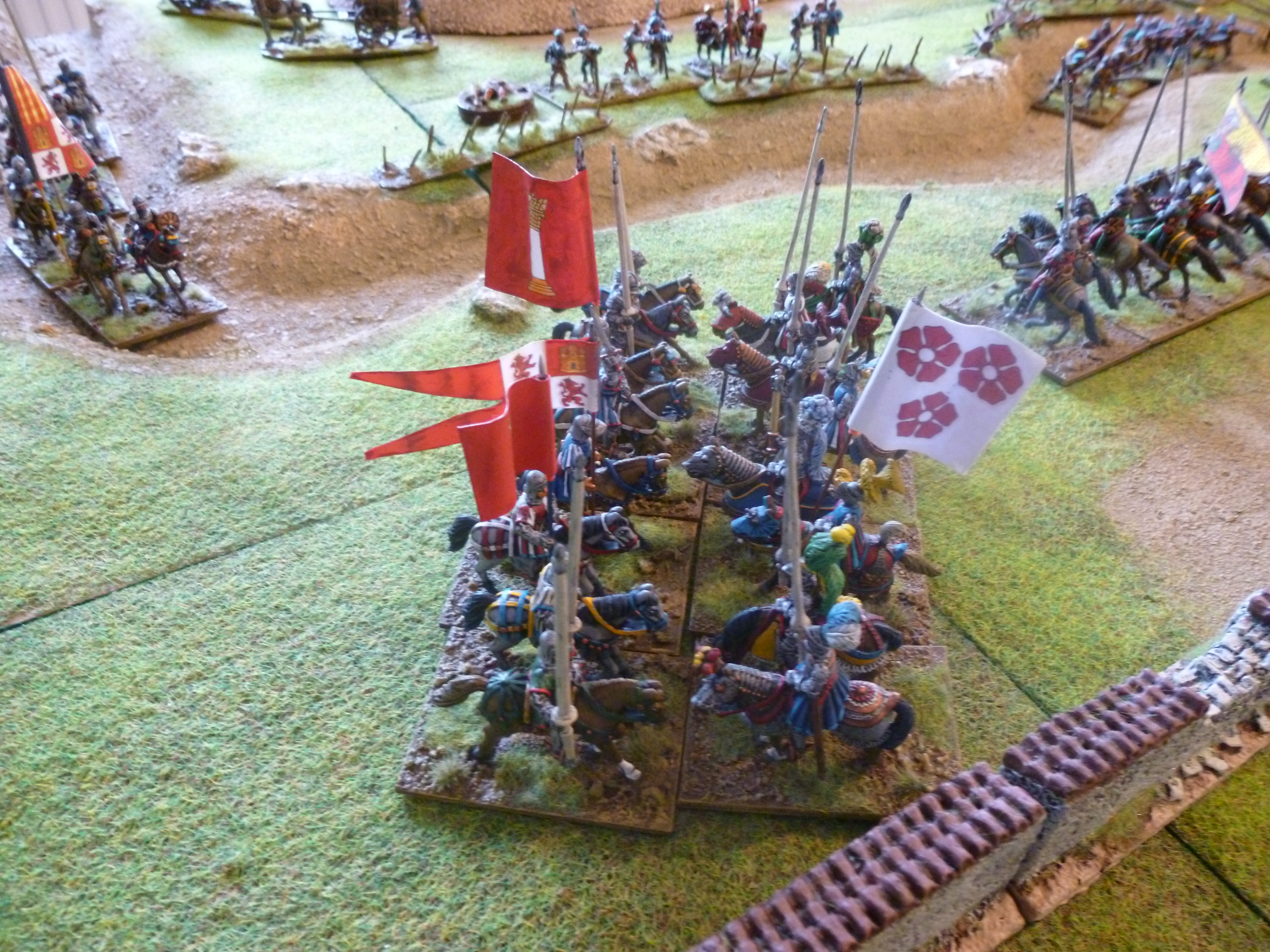
The starting deployment of the armies. In the top left hand corner are the stradiots and mounted crossbowmen of the Venetian army. Along from them is the Venetian general, Bartolomeo d'Alviano, and his heavy cavalry followed by Pietro Monte and the infantry. In the top right hand corner are more heavy cavalry under Carlo Malatesta and more stradiots. In the foreground Paul Sixt I von Trautson and his German force surround their baggage train in preparation for an attempt to break out of the Venetian snare.

The game was played as always using adapted Renaissance Rampant rules and as in the last post the units deployed were fairly large to give the impression of a pitched battle. The aims of the two armies were simple with the Germans having to exit the table from the Venetian table edge and the Venetians having to stop as many of them as possible. All the wagons and camp followers behind the landsknecht were simply table dressing, representing the camp followers the army formed a square around to protect. They had no significance in the rules. The armies used were as follows:

Sixt von Trautson's Germans

1 Unit of Foot Knights (Sixt von Trautson)
4 Units of Landsknecht Pike
3 Units of Landsknecht Shot
2 Units of Landsknecht Halberdiers

Bartolomeo d'Alviano's Venetians

1 Unit of Men at Arms (Bartolomeo d'Alviano) 
1 Unit of Men at Arms (Carlo Malatesta)
2 Units of Stradiots
1 Unit of Mounted Crossbowmen
1 Unit of Italian Pike (Pietro Monte)
1 Unit of Italian Pike
2 Units of Italian Infantry 
1 Unit of Italian Shot
1 Unit of Italian Crossbowmen

A view of the Venetian infantry under Pietro Monte.

The Venetian right flank, comprised of mounted crossbowmen and stradiots.

The Venetian general, the condottiere captain Bartolomeo d'Alviano.

Sixt I von Trautson's Germans surround the baggage train. The force comprises pike, halberdiers and arquebusiers. 

Von Trautson's force.

The German troops begin their attempt to break out of the Venetian blockade.

As mentioned above this turned out to be a disaster for the Germans. Initially they had an early success, sending one of the stradiot units that came out to meet them fleeing after one volley of shot from a unit of landsknecht arquebusiers. This turned out to be the only Venetian unit they would destroy. As the rest of the Venetian light horse rode around the German left flank and Pietro Monte's arquebusiers and crossbowmen took up position in the frozen stream the oncoming German infantry suffered. Initially the German arquebusiers fired back at the Venetians but all of the German shot were soon routed leaving the rest of their infantry to face a steady rain of missiles from the Italian ranks.

The Germans were already disordered by the time they reached the frozen stream. There were brief clashes with the Italian crossbowmen and arquebusiers holding the steam. The Italians put up a heroic defence and although the crossbowmen were pushed back Von Trautson's men could not force a way across.  Morale amongst them had fallen to such a level that when Von Trautson himself fell to the shot of an arquebusier the whole German force crumbled and began to melt away into the snow with the Venetian cavalry only too willing to chase them down.

The opening stages of the battle. The Venetian arquebusiers and crossbowmen have moved into the dried (or possibly frozen) stream bed whilst their light cavalry begin to flank the Imperialist column.

A view from the baggage train as they trudge through the snow.

The front pike blocks prepare to engage. Von Trautson is just behind them under the white Habsburg banner in the foreground.

The German force comes under attack from the Venetian shot and crossbowmen.

For a moment it looks like battle will be joined all along the front. In the top left a block of pikemen can be seen heading towards the stradiots and mounted crossbowmen in an attempt to stop them harassing the column.

Close quarter fighting breaks out as the Germans reach the stream.

The Venetian arquebusiers put up an epic defence in the stream pouring shot into the advancing Germans and preventing them from crossing the ditch.

The Venetian crossbowmen also put up a heroic defence in the stream fighting off repeated attacks.

Von Trautson's forces have faltered and failed to cross the stream and even engage with the Pietro Monte's pike and swordsmen who are waiting for them.

Von Trautson is shot dead by the arquebusiers as he attempts to lead his men in the assault.

With their commander dead the German force crumbles and flees. The Venetian light horse are not far behind them.

A view from the panicked baggage train as the German army crumbles and flees.

 As you can see it turned out to be a very one sided engagement. I think most wargamers have had these games, often more times than they would care to remember! It was interesting to see the armies deployed in the snow terrain (also known as a white sheet on the table) and this could still be a interesting battle to refight. I think the German force would need some more missile units to give them more of a chance. Von Trautson had some artillery, as we know d'Alviano was awarded some of it after the battle, but I had imagined that would have been in the baggage train rather than being deployed for the engagement. Maybe a couple of light guns, and some better dice rolls, would have given them a greater chance at breaking out of the Venetian trap.

Thursday, 21 January 2021

Cerignola, 1503


After focusing on the forces of the Ottomans and Hungarians in the past months I thought it was time to revisit the Italian Wars. Using the ever evolving Renaissance Rampant rules that I have developed with Stuart I played through a classic Italian Wars battle and famous victory for El Gran Capitan, Gonzalo de Cordoba. If you have read this blog for a while you will know I am particularly fascinated by the career of El Gran Capitan and his Spanish forces in the war for Naples. This is also a battle that James Roach  put on a spectacular demonstration of a few years back http://olicanalad.blogspot.com/2017/10/derby-worlds-cerignola-1503.html which served as great inspiration.

The armies from above, starting at the top right and going clockwise we have: Prospero Colonna and the Spanish cavalry, the Spanish infantry and landsknecht auxilliaries with Gonzalo de Cordoba and his men at arms in support and then the Spanish left flank held by jinetes. On the French side Yves d'Alegre his gendarmes and the French light horse, then the French infantry under Gaspard de Coligny and the Swiss under Tambien Chandieu and finally in the top left are Louis d'Armagnac, Duke of Nemours and Louis D'Ars and the rest of the French heavy horse.
 

Cerignola, 28 April 1503

Louis XII King of France and Ferdinand and Isabella of Spain agreed the Treaty of Granada on 11 November 1500. Although Louis XII would be the Neopolitan monarch, the Spanish King and Queen, having already been involved in the war for Naples in the 1490s, were allowed a share in the Southern Italian Kingdom, a bargaining chip Louis hoped would allow him to hold onto Milan in the north without pressure from Spain to his western borders. With hindsight it looks as though this treaty was doomed to failure as the ill defined borders between Spanish and French territory soon led to open warfare. 

Following his earlier defeat in Italy, http://camisado1500s.blogspot.com/2019/10/seminara-1495.html, and a campaign against the Ottomans in the Mediterranean, http://camisado1500s.blogspot.com/2020/09/the-siege-of-castle-of-st-george.html , Gonzalo de Cordoba, El Gran Capitan, returned to Naples having learnt from his past mistakes. He knew facing the French in the open with their heavy cavalry and fierce Swiss mercenaries would lead him to another defeat. Taking advantage of the skills his Spanish troops had learnt in the long war in Granada de Cordoba fought a guerrilla style campaign and played for time. Being outnumbered by the French forces in the peninsula the Spanish retreated to Barletta. De Cordoba refused to give in, continuing to launch raids such as the assault on Ruvo in February 1503, http://camisado1500s.blogspot.com/2014/09/ruvo-1503.html, until he was sufficiently reinforced by 2,000 landsknecht sent by Ferdinand's ally Maximilian I. 

Feeling confident that he now had an army that could face the French in pitched battle de Cordoba led his army out of Barletta. The French under Louis d'Armagnac, Duke of Nemours, took the bait and marched to confront them. El Gran Capitan earnt his sobriquet by wiseley choosing a position at Cerignola that he could entrench and roughly fortify in order to maximise the power of his arquebusiers and artillery and lure the French into attacking him. The French arrived on the heels of the Spanish army but were prevented from reconnoitring de Cordoba's position by the skirmishing of the Spanish jinetes. A row developed between the French captains over whether to attack immediately or rest and wait until morning. Nemours wanted to wait until his artillery had caught up with the rest of the army whilst others, such as Yves D'Alegre and the commander of the Swiss, Tambien Chandieu, ordered for an immediate attack. Assuming a quick victory was within their grasp the more bellicose voices in the army won the arguement and a hasty attack was launched. De Cordoba's decisive victory over them using entrenchments and arquesbusiers would become a key event in the Italian Wars and subsequent military history.

A view from the Spanish right flank under the condottiere captain Prospero Colonna's command.

A view from the other end of the field with Yves D'Alegre and the French light horse, stradiots and mounted crossbowmen on the left and Spanish jinetes on the right.

The Spanish centre is held by landsknecht auxilliaries sent by Ferdinand of Aragon's ally Maximilian I and commanded by Fabricio Zamudio. They are flanked by Spanish arquebusiers under Diego Garcia de Paredes, the "Samson of Estremedura", with El Gran Capitan, Gonzalo de Cordoba and his men at arms in reserve.

The Spanish infantry defending the widened ditch.

The French general Louis d'Armagnac, Duke of Nemours and Louis D'Ars hold the French right flank.

The reisläufer under Tambien the seigneur de Chandieu.

French pike and Gascon crossbowmen under the eagle banner of Gaspard de Coligny.

The French and Spanish infantry face each other across the trench.

The Armies

Based on what can be discerned from accounts of the battle the forces I used in the game are set out below. On the table top I really wanted to focus on the visual appeal of the game so you will notice that some of the units fielded are fairly large compared to what I normally game with. This didn't have much  of on an impact on the rules, and this didn't matter anyway as I was playing through a historical battle and taking command of both forces. Anyone who has played Lion Rampant will know that the forces take on a life of their own once the action starts anyway which is frustrating and fun in equal measure for anyone trying to control them.

In terms of the rules I divided both armies into a Cavalry and Infantry retinue while for the deployment I tried to follow historical accounts and create the "battles" deployed by de Cordoba and Nemours.

The French 

Cavalry

Louis d'Armagnac, Duke of Nemours
and Louis D'Ars in command of the French right

2 Units of Gendarmes (Louis d'Armagnac, Duke of Nemours
and Louis D'Ars )
1 Unit of Men at Arms
1 Unit of Ordonnance Archers with Demi lance

Yves d'Alegre and the French left

1 Unit of Gendarmes (Yves d'Alegre) 
1 Unit of Ordonnance Archers with Demi lance
1 Unit of Mounted Crossbowmen
1 Unit of Stradiots

Infantry

Tambien seigneur de Chandieu and
Gaspard de Coligny in the French centre

2 Units of Swiss Pike
1 Unit of Swiss Arquebusiers
1 Unit of French Pike
2 Units of Gascon Crossbowmen

 The Spanish

Cavalry

Prospero Colonna on the Spanish right

1 Unit of Men at Arms (Prospero Colonna)
1 Unit of Men at Arms
1 Unit of Jinetes

The Spanish left

1 Unit of Jinetes

Infanty in the Spanish centre

Fabricio Zamudio and Diego Garcia de Paredes, the "Samson of Estremedura"

2 Units of Landsknecht Pike
4 Units of Spanish Arquebusiers    
1 Unit of Spanish Pike 
2 Units of Rodeleros

The Spanish reserve, behind the infantry under Gonzalo de Cordoba and Pedro Navarro

1 Unit of Men at Arms (Gonzalo de Cordoba)
1 Gun (Pedro Navarro)

From above you will be able to see that the forces fielded were fairly small, although lots of figures were deployed for each unit. This meant that I could play through a large battle fairly quickly as although the units look large they could be "broken" quickly once the game started. As always the best way to follow the game is through the photo captions.

Unlike the historical battle the attack starts with D'Alegre's stradiots and mounted crossbowmen leading the assault along with Coligny's Gascon crossbowmen.

Under a rain of crossbow bolts some of the Spanish arquebusiers are forced back.

The problem with refighting this battle is once you know the ditch is in front of the Spanish lines it is very difficult to play it as it was with the French gendarmes and the Swiss heading straight into a headlong assault on the Spanish position. In this refight the game started with the French light horse under D'Alegre and the Gascon crossbowmen launching a "softening up" attack on the Spanish lines. This proved remarkably successful. The jinetes on the Spanish left flank were quickly chased off by the stradiots while the mounted crossbowmen and Gascons forced some of the rodeleros and Spanish pike to fall back. To counter this the Spanish arquebusiers moved forward, still under the cover of the widened ditch.

Once the Spanish arquebusiers were in range a fierce firefight developed but the fact that the Spanish were in good cover meant that the French had to push forward to avoid taking further casualties at their hands. At the far end of the field the Duke of Nemours gendarmes were attacked by skirmishing jinetes. Unbelievably they scored a lucky hit and managed to bring the French general down! While he may have not met his end at the hands of an arquebusier he was still obviously fated to fall early on in this refight.

As the Spanish jinetes on de Cordoba's right flank are seen off the Spanish arquebusiers enter the ditch in an attempt to draw in the French. More stradiots have arrived as French reinforcements on the French right flank.

A fierce fire fight has developed between the Gascons and Spanish shot.

A view of the fighting as it develops.

The Spanish jinetes on the Spanish right flank begin to engage some of the French heavy horse.

The Spanish left flank is being beaten back.

During a skirmish attack by Spanish jinetes, the French general Louis d'Armagnac, Duke of Nemours is slain!

Untroubled by the fact that their general had been slain the French infantry and light horse pressed home their attack on the Spanish centre. Leading the landsknecht in a counter attack across the ditch Fabricio Zamudio was slain by the Gascons. On the French left the heavy cavalry now moved into action. The jinetes who had killed Nemours were unable to evade a furious charge by the gendarmes and were quickly defeated. This in turn put some of the French heavy horse within range of the Spanish shot who opened fire on them. In an effort to avoid this fire and press home the assault the gendarmes rode into the Spanish men at arms who were waiting behind the fortifications. A chaotic cavalry melee developed and the already disordered French cavalry were defeated in the difficult terrain.

A full on attack is launched on the Spanish infantry and landsknecht in the centre.

In revenge for the death of their captain, the Duke of Nemours retinue charge down the jinetes.

As the landsknecht launch a counter attack on the Gascons, their captain, Fabricio Zamudio, is slain.

As Diego Garcia de Paredes arquebusiers begin to fire murderous volleys into the reisläufer, they are forced to attack the ditch. 

A view from above with the battle in full swing.

The landsknecht briefly force the French assault back...

... only to be forced back by the weight of French numbers.

A chaotic cavalry melee has developed between the Spanish men at arms and disorganised French gendarmes.

The Spanish left flank has been completely turned.

A view of the French attack on the ditch.

As the Swiss attempt to force the ditch their numbers are thinned by the Spanish arquebusiers.

Having lost their skirmishing arquebusiers to the Spanish guns the Swiss launched a charge on the Spanish position. They reached the ditch but suffered terrible casualties as this part of the Spanish position had not been involved in the duel with the Gascons and light horse. The Swiss were effectively stopped, causing little damage to the Spanish lines. This was to no avail as although the reisläufer had been checked by now the stradiots and Gascons were within the Spanish defences having broken through on the Spanish left.

On the Spanish right flank Prosepro Colonna lead his troops into Louis D'Ars gendarmes, defeating them and then rolling up the French heavy cavalry wing. This allowed de Cordoba and Colonna to escape with the Spanish men at arms in relatively good order, in fact not a single heavy cavalry unit had been lost. For the Spanish and landsknecht infantry it was a different matter. Yves D'Alegre and his cavalry swept into the Spanish position while Gaspard de Coligny's French infantry were also in relatively good shape. As the evening drew in some of the French guns began to arrive and it was clear that the field was theirs.


t
The Spanish have some luck on their right flank where Prospero Colonna leads a counter attack that pushes Louis D'Ars and his gendarmes back.

The seigneur de Chandieus reisläufer force a way across the ditch despite suffering terrible casualties.

The Spanish and landsknecht in the centre have been defeated with only the Spanish cavalry on their right flank escaping undefeated. As the light fails some of the French guns begin to arrive but they are not needed.

 This was a fascinating battle to refight and was not as one sided as I thought it was going to be, especially as once the surprise element of the ditch was removed it gave the French more options as to how to tackle the Spanish defences. With the French light horse and Gascons attacking first it really changed the nature of the fight, helped a lot by the chaotic nature of the rules! Having said that the Spanish shot behind and in the ditch were still really formidable and did manage to effectively wipe out the Swiss with them barely getting into any combat. With a few tweaks and special rules, such as the Spanish powder wagon blowing up as is reported in some accounts, this could be a game to visit again in the future.